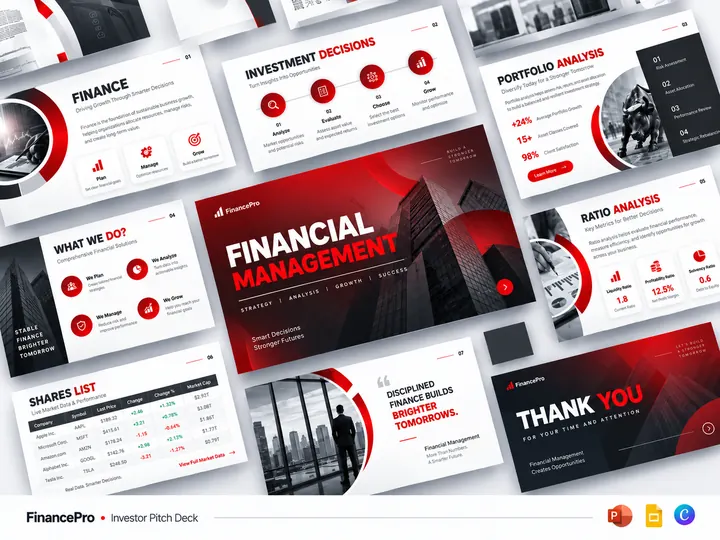
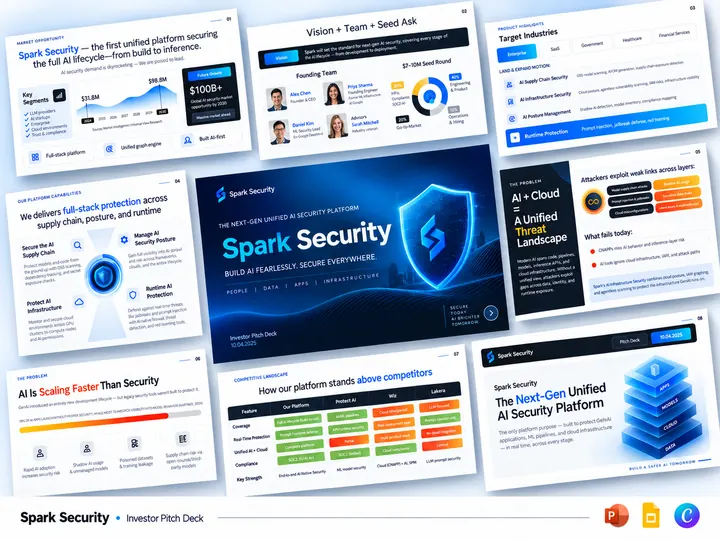
Recent work
View full portfolio →
Investors decide in minutes. We design decks that make the decision easy — narrative first, numbers visible, nothing to explain away. Our clients' decks have supported $22.8M+ in funding.
From $300 · 12–18 slides · 5–10 working days · editable PowerPoint or Google Slides
An investor pitch deck has a job most decks never have: it must survive being read without you in the room. It gets forwarded to a partner who wasn't on the call, skimmed on a phone between meetings, and compared against nine other decks that week. Design that only works when you're narrating it isn't design — it's decoration.
We build investor decks the way an analyst builds a case: the argument gets structured before anything gets styled. What is the opportunity, why now, why this team, and what exactly does the money buy? When those answers are clear, the design's job becomes simple — make each one impossible to miss in under eight seconds a slide.
That approach has supported $22.8M+ in client funding across pre-seed rounds, growth raises, and one film financing that closed at $20M. It's also why our clients tell us the same thing after pitching: the questions they got were about the business, not about what a slide meant.
Investors don't buy features — they buy a thesis. We structure your raise as an argument that builds: problem, insight, traction, ask. Every slide advances it or it gets cut.
Your metrics are the deck's credibility. We visualize traction, unit economics, and projections so the strongest number dominates each slide and the underlying logic stays visible.
Decks get sent, not just shown. Slide headlines carry the meaning on their own, so the deck still argues your case when you're not there to narrate it.
You receive the working PowerPoint or Google Slides master — not a locked PDF. Raises change; your deck needs to change with them without coming back to us.
You approve a sample slide before full production begins — so you see the direction, and the fee, before committing to the full deck.
Your existing deck, financial model, notes, or just a call transcript. We work from whatever exists — including nothing but a business summary.
We redesign one representative slide first. You confirm the visual direction and narrative approach before the full build starts.
Narrative structure, slide headlines, data visualization, and a coherent visual system across every slide, including the appendix investors actually read.
Editable master files plus PDF export, with revision rounds until you are ready to send it.
Most founders ask how many slides. The better question is which arguments must land. A seed deck and a Series A deck differ less in length than in burden of proof: seed sells the insight and the team, Series A sells repeatability — that the machine works and capital makes it work faster.
In practice, the decks that get second meetings cover: the problem framed as a market reality rather than a complaint; the insight that makes your approach non-obvious; product shown, not described; traction with honest denominators; a market size built bottom-up (investors discount top-down numbers instantly); the business model in one line; competition acknowledged with a real position rather than a flattering quadrant; the team's specific right to win this; and an ask that states what the money buys in milestones, not months of runway.
The appendix does more work than founders expect. Cohort detail, churn breakdowns, pipeline, and hiring plans belong there — out of the main narrative, ready when a partner digs in.
The most common failure isn't ugly slides — it's a deck that makes the investor do the reasoning. Twelve bullet points of context and no stated conclusion means the reader assembles the argument themselves, and every reader assembles a slightly different one. Slide headlines that state the takeaway ("Retention improves with cohort age") instead of the topic ("Retention") fix more pitch problems than any visual change.
The second failure is unearned confidence: hockey-stick projections with no assumptions shown, a market size that assumes total capture, a competitor slide where you win every row. Sophisticated investors read those as signals about judgment, not about the business. We'd rather show a defensible number and the reasoning under it.
“He jumped on it and, like an expert, he understood the ‘story’ I was trying to tell with the deck. He then quickly turned around the first version and, in that one attempt, nailed what I was looking for.”✓ Verified 5-star review
Fixed quote before work starts. No hourly billing, no scope surprises.
Rush delivery available. Every tier includes a sample slide for approval, editable source files, and structured revision rounds.
Typically 5–10 working days from approved sample to final files, depending on slide count and how ready your content is. If you have a date — a demo day, a partner meeting — tell us and we will work to it; rush delivery is usually possible.
Both, collaboratively. We restructure narrative flow and rewrite slide headlines so each slide states its takeaway. We do not invent metrics or claims — the substance comes from you, the argument and its presentation come from us.
Whatever exists: a current deck, a financial model, a business summary, or notes. Add your logo, brand colours, and the audience you are pitching. The intake form takes about ten minutes.
Yes. NDAs are welcome and signed on request. Client material is used only to produce your deck, and nothing appears in our portfolio without written permission — much of our best work is never shown publicly.
Yes, and we prefer it. Send your brand guide, fonts, and templates and the deck will be built inside your system. Where guidelines conflict with legibility in a pitch setting, we will flag it and propose an alternative rather than silently overriding your brand.
Editable PowerPoint (.pptx) or Google Slides — your choice — plus a PDF export for sending. Fonts and assets are packaged so the deck renders correctly on someone else's machine.
Yes. Seed decks sell the insight; Series A and later sell repeatability and unit economics, which changes both the structure and the depth of the data work. We adjust the narrative accordingly.
Structured revision rounds are included in every tier, and we keep working until the deck is right. The sample-slide approval step means large-scale direction changes are rare by the time full production begins.
Send your current material and get a plan plus a fixed quote within hours — usually faster.