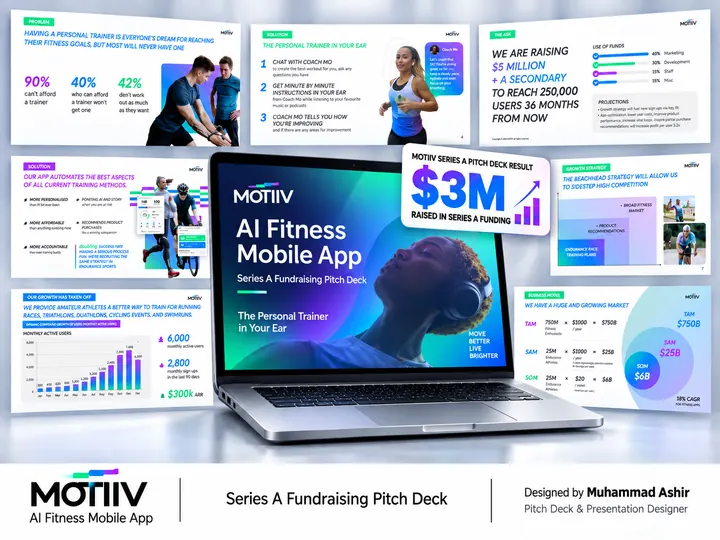
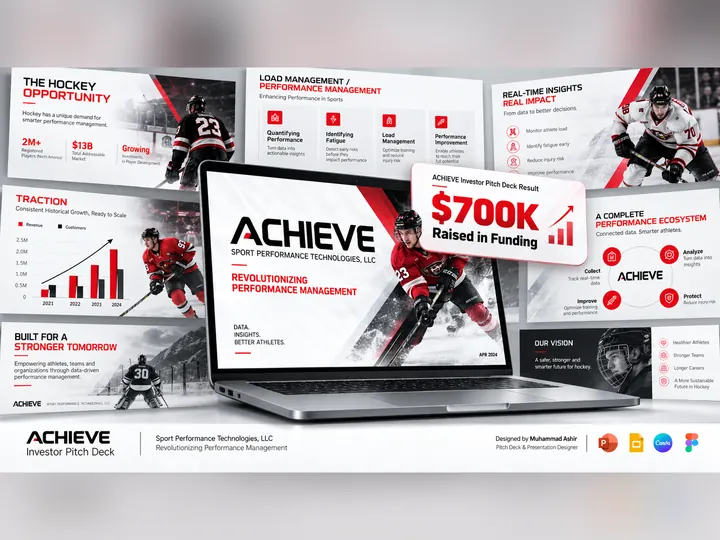
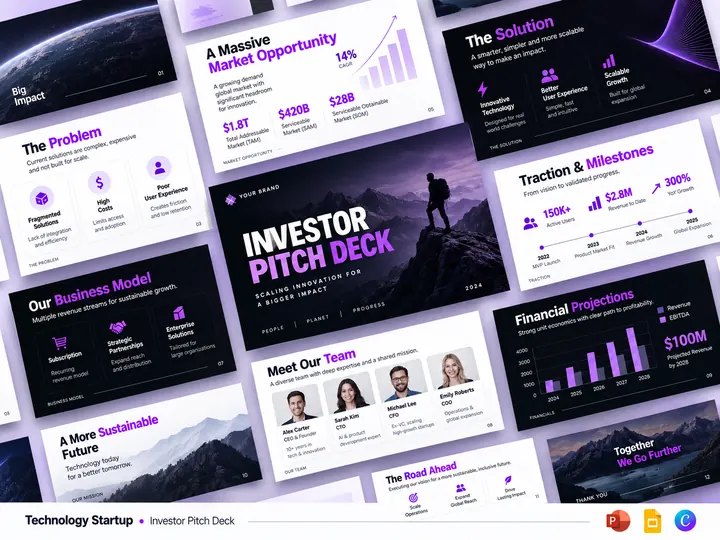
Recent work
View full portfolio →
Early-stage decks have a different job: you're selling an insight and a team, not a track record. We design for that — clearly, honestly, fast.
From $300 · founder-friendly turnaround · editable files · sample slide before you commit
A pre-seed deck and a Series B deck are not the same document with different numbers. At the earliest stage you're asking someone to fund a belief: that this problem is real, that your insight into it is non-obvious, and that this specific team will keep going when the first plan fails. Traction helps, but it isn't the argument yet.
Most early-stage decks get this backwards. They open with a product tour, bury the insight on slide nine, and pad the middle with market numbers that assume total capture. Investors — who see dozens of decks a week — read that as inexperience before they've evaluated the business.
We've designed decks across pre-seed through growth rounds, and the pattern that works early is consistent: a sharp problem, a specific insight, evidence you're the team to act on it, and an ask that shows exactly what the money buys.
Small numbers presented with the right denominators and the right framing beat inflated ones every time — investors check, and credibility is your scarcest asset.
We lead with why this approach is non-obvious, then show the product as evidence. Feature tours belong later, or in the appendix.
Not "passionate team" — the specific reason your background makes this the right thing for you to build.
From $300, with a sample slide before you commit. Fundraising timelines don't wait for design cycles.
Built to fit fundraising timelines, not agency timelines.
A messy deck, a memo, a data room, or a call transcript. Founders rarely start with clean material and we do not expect it.
See the direction on one of your own slides before the full deck is produced.
Narrative structure, slide headlines, metric visualisation, and a coherent design system across the deck plus appendix.
Editable files you can update mid-raise as conversations sharpen the story.
Across the decks we've built, three slides do disproportionate work. The insight slide — the one sentence explaining why this is possible now and wasn't before. The traction slide — whatever real evidence exists, presented with honest denominators and a visible trend. And the ask slide — what the money buys, expressed as milestones that unlock the next round rather than as months of runway.
Everything else supports those three. If your market slide, competition slide, and product slides don't feed one of them, they're taking up room a partner's attention could be spending elsewhere.
Pre-launch founders often try to hide this with projections. It doesn't work — experienced investors discount forecasts automatically and notice the evasion. The stronger play is to substitute a different kind of evidence: customer interviews with real quotes, a waitlist with conversion detail, letters of intent, a working prototype, or a founding team with an unusual and specific advantage.
The framing that lands is a clear statement of what you've validated so far, what you haven't, and precisely what this round buys you the chance to prove. That reads as judgment — which, at pre-seed, is much of what's actually being funded.
“Muhammad is an exceptional talent. Easily in the top 2% of anyone we have worked with.”✓ Verified 5-star review
Transparent, fixed, and quoted before we start.
Sample slide approval included at every tier. Rush delivery available when a deadline is fixed.
If you're raising, the deck is the artefact your business gets judged by before anyone meets you. Ours start at $300 — the relevant comparison isn't the cost, it's what a weaker deck costs in meetings that never happen.
Usually 12–16 in the main narrative, with an appendix for detail. Length matters less than whether each slide earns its place — investors skim first and read second.
Yes. We restructure narrative order and rewrite slide headlines so each states a takeaway. We don't invent metrics or claims — substance comes from you.
Standard is 5–10 working days; rush is usually possible. Tell us the date at the start and we'll confirm honestly whether we can meet it.
Yes, on request, before you share anything sensitive.
Yes — and you'll have editable files to make quick changes yourself. Many founders return for a refresh between the first partner meetings and the final rounds of diligence.
Send whatever you have — even if it's messy. Fixed quote within hours.